

From “China Speed” to “China Rigidity”: The Hidden Challenge of the Last 30 Years
Over the past thirty years, engineering and construction within China’s pharmaceutical and life sciences sector have demonstrated internationally recognized rapid progress as called “China Speed”. We have built one of the world’s largest and most complete manufacturing ecosystems, laying a solid physical foundation for the advancement of healthcare.
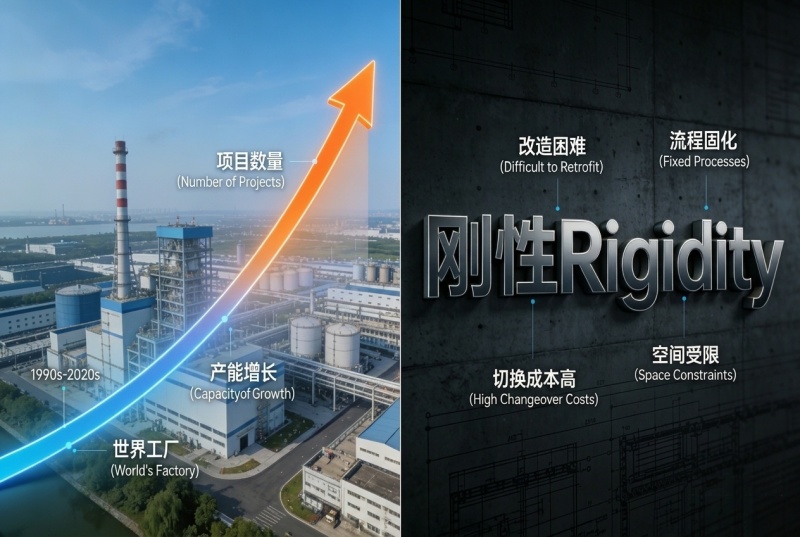
This is an accomplishment we can all be proud of. In the chart below, we’ve condensed this thirty-year leap into a steep growth curve on the left.
However, after a deep dive into our experience from over 3,000 projects, a keyword emerged as the counterpoint to “Speed.” We’ve placed it on the right side of the chart: “Rigidity.”
This “rigidity” wasn’t a mistake, but rather an inevitable choice during a specific historical period. In the pursuit of scale and efficiency, we built a vast number of “rock-solid” facilities defined by:
- Physical Rigidity:Core structures of reinforced concrete, once built, are extremely difficult and costly to retrofit or upgrade.
- Process Rigidity:Production lines tailor-made for a single “blockbuster drug” struggle to adapt to the future demand for multi-product, small-batch personalized therapies.
- Mindset Rigidity:A long-established “civil-engineering-first” model leaves us lacking more agile and flexible solutions when facing uncertainty.
“Speed” won us the past, but excessive “Rigidity” is now becoming a heavy burden holding us back from the future. It doesn’t just mean inflexible individual facilities; at a macro level, it leads to a severe resource mismatch. When market demands evolve rapidly, these fixed, older facilities cannot pivot, leading to idle and excess capacity. Meanwhile, to catch the next wave of technology, we are forced to plan new industrial parks and engage in another round of repetitive infrastructure construction. This is a colossal waste of capital, land, and time.
As the industry wave shifts towards cell and gene therapies, how can we break free from this cycle of “build, demolish, and rebuild”? How do we escape these constraints?
This is the core question we want to explore in the coming weeks.
But first, we’d like to hear from you: In your professional experience, have you also felt the challenges posed by this “rigidity”? In what ways does it typically manifest?